
Absolutely thrilled with the work from Sydney Gardeners! The team transformed our overgrown backyard into a beautiful, low-maintenance garden. They were professional, punctual, and paid attention to every detail. Highly recommend their services!
The planting professionals
Garden Planting Services Sydney
Chosen for the position, planted so they live, and spaced for what they become rather than the size of the pot. Beds prepared properly, mulched, and checked through the first summer.
Rated 5 out of 5 by our customers
- Beds prepared before anything goes in the ground
- Spaced for mature size, not for the day it looks full
- Screening, hedging, natives, cottage beds and pots
- Open 7 days, 7am–6:30pm
Request a planting quote
Suburb, which way the bed faces, and what you want it to do — screen a neighbour, fill a gap, or start again. Photos help.
Google reviews
What customers say about our garden planting
Real reviews from our Google Business Profile, word for word.
I highly recommend Sydney Gardeners to anyone seeking professional garden design and maintenance services. Their commitment to excellence, creativity, and client satisfaction is unparalleled, and I am thrilled with the beautiful garden they've created for me. Thank you, Sydney Gardeners, for turning my garden dreams into reality!
Sydney Gardeners provide exceptional services. Their team is professional, efficient, and knowledgeable. They transformed my garden beautifully, exceeding my expectations. Highly recommended for all gardening needs!
Great communication and exceptional workmanship. The team arrived on time and did an amazing job with pruning, planting, and lawn care.
Been getting great service and value from Sydney gardeners now for a number of years, always great high quality work in my feature gardens. Attention to detail is second to none. No job to big for these boys to tackle.
I'm very happy with Lachlan and his team at Sydney Gardeners. They did a professional, clean and well-rounded job. I would highly recommend their work.
Planting looks like the easy part of gardening, and the failure rate says otherwise. Most plants that die in a Sydney garden are not killed by disease or neglect — they are killed in the first twenty minutes, by a hole that was the wrong shape, a root ball set too deep, backfill that turned the hole into a bucket, or a plant that was never going to cope with a west-facing wall in February.
The second failure is slower and much more expensive: planting for the size of the pot instead of the size of the plant. A row of lilly pillies at 600 mm centres looks perfect for two years, and then becomes a solid wall of competing trunks that has to be ripped out. The gap that looks embarrassing on day one is the whole point.
We plant screening and hedges, garden beds, natives, courtyard and pot planting, and replacement planting where something has failed and nobody is sure why. Beds get prepared before anything goes in, everything is chosen for its actual position, and we come back through the first summer, which is when it is decided.
What it changes
Benefits of Professional Garden Planting Services
Not "it looks nicer" — the benefits are mostly about what is still alive and the right size in five years.
-
Enhanced Garden Health
Most of this is decided below the surface. Bed preparation through the whole bed rather than a spadeful of good soil in each hole, root balls teased apart so roots leave the shape of the pot, planting level rather than deep, and mulch kept off the stems. None of it is visible on the day and all of it decides year three.
-
Aesthetic Harmony
Structure first, then colour. A bed that reads well has a backbone of evergreen shapes, repetition rather than one of everything, and heights that step down towards the front. Flowers are the last ten per cent. The most common mistake we are called in to fix is a bed of fifteen different plants with no repeated element anywhere.
-
Biodiversity Boost
Small birds need something to hide in. Dense, prickly or fine-leaved natives — grevillea, callistemon, westringia, banksia, lomandra — bring in wrens and honeyeaters rather than just the noisy miners that dominate open, over-pruned gardens. Layered planting does more for a block than any single specimen tree.
-
Stress-Free Experience
Somebody else carries the bags and the risk. We source the stock, check it before it goes in, dispose of pots and packaging, and warrant the planting through establishment provided the watering regime is followed. If something fails in the first season, that is a conversation rather than a re-purchase.
The twenty minutes that matter
How a plant should actually go in the ground
This is the single most useful diagram on this page, and it applies whether we do it or you do. Nearly every plant we are asked to replace was put in the way the left-hand side shows.
-
Planted too deep
The commonest of all. Bark that evolved to be in air sits in damp soil, and the collar rots. If you cannot see where the stem flares out into roots, it is too deep. This is also what happens when people mound mulch up against a trunk.
-
Never watered in properly
Watering in is not about moisture, it is about settling soil into the air pockets around the roots. A root ball sitting in an air gap dries out no matter how much you water afterwards. It wants a slow, heavy soak on the day, then deep soaks rather than daily sprinkles.
-
The wrong plant for the aspect
A west-facing brick wall in a Sydney February is a different climate from the same garden four metres away. Shade-lovers cook there, and sun-lovers sulk in dry shade under a gum. Nothing you do afterwards fixes a plant in the wrong position.
-
Left alone through the first summer
A new plant has a root system the size of its pot, in soil that dries from the top down. It needs deep watering through its first summer even if it is a drought-hardy species — the drought tolerance comes later, once the roots are out.
Mature size
Spacing: planting for what it becomes
Everything in a nursery is the same size. Five years later it is not. These are common Sydney garden plants drawn to scale, against the 200 mm pot you would buy them in.
More Google reviews
Sydney homes and businesses we've looked after
Unedited reviews straight from Google — the same crews, the same standard.
Great service, friendly staff, my garden looks amazing.
Can't thank Lachlan and the rest of the team enough for the professionalism and outstanding service I have received. I have been using their services for the past 18 months and I am always impressed with the results of their work. Highly recommended.
Great job on my garden
Incredible service, excellent communication skills and a pleasure to work with! Would definitely recommend to anyone looking to maintain or brighten up their garden! Thank you
I highly recommend Lachlan and the team at Sydney Gardeners. Not only do they do great work, but more importantly they are reliable! Lachlan was also more than happy to help me out when I needed an extra service squeezed in just before Xmas.
Lachlan and his team have been looking after my Strata Property for over 2 years now. He is diligent with his timekeeping, punctual, provides attention to detail and does not hesitate to go above and beyond to provide satisfaction to our strata residents and property management team.
My first time using Lachlan from Sydney Gardeners. I had overgrown high hedges to be significantly cut back and I was impressed with the finished job. I will be using them again and recommend him for all your gardening needs.
Sydney Gardeners helped us clean up our backyard after months of neglect. The team was punctual, friendly, and worked efficiently. Our lawn and hedges now look fantastic. Would happily use them again.
Lachlan did a great job mowing my lawn!
Greatest gardening service ever, couldn't be happier.
Lachlan and his men have been doing my garden for some years. My hedges and trees are beautifully trimmed every time. I share the same experience with the majority, those with excellent reviews.
Lachlan and his team were fantastic. They were professional and did the job in a timely manner. He gave me some great insights on how we could develop our business garden.
Very happy with the job Lachlan did mowing and pruning at our home. He was very pleasant to deal with and did a great job with prompt service. Thank you
Lachlan provided high quality gardening services including trimming of trees on our property in Mosman. We were very happy with the excellent communication, efficiency and professionalism. We would be happy to recommend Lachlan to friends and family.
Highly recommend. They took over from long-time gardeners for our apartment building and Sydney Gardners standard is far greater and less expensive.
Great quality work and professional service. Was very happy with the job that was done! Will definitely be using these guys again 😊
Lachlan did a great job mowing and edging the property. Only just starting using them. Very happy
Great gardener with a very strong work ethic and excellent attention to detail. Well priced and timely.
Lachlan is very professional and hard working. Highly highly recommend.
Thank you so much. You guys did a great job. I will be a continuing customer.
Professional and polite. They did exactly what I wanted. Highly recommend.
Amazing service, highly recommend!
Prompt and excellent service
My usual gardener wasn't available to me so I decided to go with the guys at Sydney Gardeners. I was surprised with how quickly they managed to do the job (I have a large backyard with hedges).
These boys did a great job, very responsive, very professional.
Great service, extremely timely and professional. Thanks!
Would highly recommend to anyone looking for any gardening maintenance needs
Excellent service and quick, helpful responses.
Sydney Gardeners were amazing at working on my lawn and the rest of my backyard. They were very friendly and enthusiastic to complete the job.
The guys at Sydney gardeners serviced my gardens with a professional manner, it's rare to find a quality gardening service in Sydney that is this good now-days.
Super helpful!!
Stock size
Should you buy big plants or small ones?
Advanced stock is the most tempting line item in any planting quote and usually the easiest place to save. Here is the shape of what actually happens.
So when is advanced stock worth it? When you need a screen for a specific reason now — a new neighbour's window, a rental going to market, a shade tree over a play area for a child who is currently five. It is also worth it for one or two feature specimens where the plant is the point of the garden. What it is rarely worth is a whole bed, and never worth it if the watering afterwards is not going to happen: a big plant in dry ground fails faster and more expensively than a small one.
The sensible compromise on a hedge is to buy the size that lets you plant more of them. Twenty 200 mm plants at correct spacing will close into a hedge sooner than eight advanced ones spaced too far apart, and cost less doing it.
Plant selection
What we plant, and what we will talk you out of
We will plant whatever you want — it is your garden. But there are a handful of plants we will always raise a flag about first, and the reasons are practical rather than snobbery.
Reliable across Sydney
- Screening: lilly pilly in the psyllid-resistant forms, viburnum, murraya, photinia, and pittosporum where there is room
- Dry shade under established trees: clivia, liriope, dianella, hellebore, plectranthus, native violet
- Coastal and windy blocks: westringia, coastal rosemary, banksia, correa, lomandra, pigface
- Hot west-facing positions: agave and succulents, salvia, rosemary, gaura, callistemon
- Structure and repetition: camellia sasanqua for shade, gardenia for a fragrant low hedge, magnolia ‘Little Gem’ where there is height to spare
- Small-bird habitat: grevillea, callistemon, hakea, prickly-leaved natives that give something to shelter in
We will flag these first
- Running bamboo without a root barrier — it will not stay in your yard, and it becomes the neighbour's problem too
- Ficus, liquidambar, poplar and willow anywhere near pipes, paving or a boundary; the roots are the whole story
- Umbrella tree, camphor laurel, privet and cocos palm — weedy, bird-spread, and a problem for the bush if you are near it
- Agapanthus and gazania on a bush-edge block, where they escape into the reserve
- Anything sold as "fast growing screening" without a mature size on the label; fast means it does not stop
- Deciduous exotics right over a pool or a gutter line, unless you enjoy the consequences
Autumn is the best planting season in Sydney, not spring
The soil is still warm from summer, the wettest months are ahead rather than behind, and a plant that goes in during March or April has six months to get its roots out before it has to survive a January. Spring planting works and is the second-best window; midsummer planting means committing to daily attention through the hardest part of the year. If you are planting in December because that is when you are free, it is doable — just be honest with yourself about the watering.
How we work
Our Process for Garden Planting Services in Sydney
Six stages. The two in the middle are where the plants that survive get chosen.
-
Client Consultation
What the bed has to do, before what it should look like — screen a window, soften a fence, handle a dog, be safe for small children, be low enough to see over, need almost no upkeep. We also want to know what you like and what you have killed before, which is usually the more useful of the two.
-
Site Assessment
Aspect and hours of direct sun, existing root competition from trees, soil type and how the bed drains, exposure to salt or wind, and what is already thriving there — the best evidence about a garden is what is doing well in it. We dig a hole and fill it with water where drainage is in question.
-
Customised Planting Plan
A plan with named species, quantities, pot sizes and spacing set from mature width. You see it and can change it before anything is ordered. It includes what it will look like at planting and at three years, so the gaps are expected rather than alarming.
-
Professional Planting
Bed preparation through the whole bed rather than hole by hole, root balls teased out, planting level, watering in hard to settle the soil, then 75 mm of mulch pulled back from every stem. Stock is checked before it goes in — anything root-bound or stressed goes back rather than into your garden.
-
Post-Planting Care Guidance
A written watering regime for the first twelve months, which is the only part that really matters: deep soaks, spaced out, tapering as roots establish. Plus when to first fertilise, when to first prune, and what normal transplant sulk looks like so you do not panic and overwater.
-
Follow-Up and Support
We check back through the first summer, because that is the test. If something fails and the regime was followed, we replace it. Most clients fold this into regular maintenance, which means the beds get watched by someone who knows what was planted and why.
Why us
Why Choose Sydney Gardeners for Your Garden Planting Services
Twenty-plus years, family operated, and we are usually still maintaining the beds we planted — which is the strongest possible reason to plant them properly.
-
Expert Horticulturists
The useful expertise is unglamorous: knowing that a plant is root-bound before it goes in, that a bed under a gum is competing for water rather than short of it, and which lilly pilly forms resist psyllid so the hedge is not permanently pimpled.
-
Tailored Solutions
Aspect, soil, root competition, exposure and how much upkeep you actually want. A plan for a shaded inner-west courtyard and a plan for a windy Northern Beaches frontage share almost nothing, and neither should be a catalogue selection.
-
Sustainability Focus
Locally suited planting that does not need constant propping up, natives that support small birds and insects, mulch to hold soil moisture, and a firm no to anything known to escape into bushland. Sustainability here means fewer inputs, not a label on a pot.
-
Quality Assurance
Stock inspected on arrival, planted to a consistent method by crews trained the same way, and warranted through establishment when the watering regime is followed. If a plant is wrong for the position we say so before it is bought, not after it dies.
-
Personalised Customer Experience
You get the plan in plain language with the plant names on it, so in three years you know what that thing in the corner is called. And you get told when what you are asking for is a bad idea, which is the part that actually saves people money.
75 mm
Mulch on every bed, pulled back off the stems
12
Months of watering guidance with every job
$0
Site visit and planting plan quote
Questions
Garden Planting Services in Sydney FAQs
What types of plants do you specialise in planting?
Screening and hedging, native and habitat planting, structural shrubs, ground covers for dry shade, cottage and perennial beds, ornamental and small feature trees, and pot and planter schemes for courtyards and balconies. Natives and exotics both — the useful distinction is not native versus exotic, it is suited to the position versus not. What we do not do is fruit orchards at scale, or large tree transplanting, and we will say so rather than have a go.
How do you ensure the plants will thrive in my specific garden conditions?
By assessing the position before choosing anything. That means hours of direct sun and at what time of day, aspect, soil type and drainage — sometimes literally digging a hole and filling it with water to see how fast it goes down — root competition from nearby trees, and exposure to salt or wind. Then plants are matched to that, not to a look. The other half is the planting method itself: wide holes, teased roots, planted level, watered in and mulched, plus a watering regime for the first year.
Can I request specific plants or a particular aesthetic for my garden?
Of course, and most people do. Bring photos, a Pinterest board, a plant you saw down the street — all useful. We will work with it, and where something on the list will not survive in that spot we will say so and offer the nearest thing that will. It is your garden; our job is to make sure what you want is still there in five years.
When is the best time to plant in Sydney?
Autumn, and it is not close. March to May gives you warm soil, the wetter months ahead and six months for roots to establish before the first serious heat. Spring is the second-best window and is fine for most things. Midsummer planting is possible but commits you to daily attention through the worst of it, and planting into a heatwave is a genuinely bad idea. The exception is anything frost-tender in the colder pockets of the Hills, which is better going in during spring.
How much does garden planting cost?
It is quoted, because the plants are often the smaller half of it. The cost is driven by bed preparation, how much soil and mulch has to be brought in, access for getting materials to the bed, the number of plants and their pot size, and whether anything has to be removed first. A courtyard bed replanted is a modest job; a full screening hedge with soil improvement along a boundary is a bigger one. You get an itemised quote, and swapping pot sizes is the easiest lever if the number needs to come down.
Do you guarantee the plants?
We warrant our planting through establishment, provided the watering regime we give you is followed. That is not a technicality — the overwhelming majority of first-year deaths are water, either too little or a daily sprinkle that never soaks in. Where we also maintain the garden, the watering is our responsibility and the warranty is simply ours to honour.
Should I buy advanced plants or smaller ones?
Smaller, in most cases. Advanced stock spends a year or two rebuilding roots that were cut to fit the pot, while small stock roots away immediately, so they typically converge around year three and the small ones often pass. Advanced plants are worth it when you need screening now for a specific reason, or for one or two feature specimens. On a hedge, buying more smaller plants at correct spacing closes the gap faster than fewer large ones spaced too widely.
Do you supply the plants, or can I?
Either. We normally source them, because we can check the stock before it goes in and reject anything root-bound or stressed, and because we know which growers have decent material. If you would rather buy your own, that is fine — we will give you a list with sizes and quantities. The only thing we ask is that we see the plants before planting, since our establishment warranty depends on what went in the ground.
What soil preparation do the beds need?
More than most people expect, and it is done across the whole bed rather than hole by hole. Compacted or builder's-fill soil gets broken up, compost and organic matter is worked through the full planting depth, and drainage gets addressed if water sits after rain. Shrubs want a decent depth of workable soil, not 100 mm of nice soil over compacted clay. Improving only the hole is worse than not improving it at all in clay, because you have created a sump.
Are natives lower maintenance?
Often, but not automatically, and only once they are established. A native suited to the position needs less water, less feeding and less fussing, and supports local birds and insects. A native from a completely different climate — and plenty sold in Sydney are from Western Australia — can be fussier than an exotic that has been grown here for a century. Also worth knowing: most natives dislike phosphorus-rich fertiliser, so they need different feeding rather than no feeding.
How do I look after everything after planting?
Deep and infrequent, from the first day. Roughly: a heavy soak at planting, then every two or three days for the first fortnight, twice a week through the first couple of months, then weekly through the first summer, tapering after that. Adjust for rain and for how quickly your soil dries. Keep mulch at 75 mm and clear of the stems, hold off fertiliser for six to eight weeks, and expect a period of sulking that is not the same thing as dying.
Which areas of Sydney do you cover for planting?
All of them — the North Shore, Northern Beaches, Eastern Suburbs, Inner West, CBD, Western Sydney, the Hills District and Southern Sydney. The plant list changes noticeably across those — a coastal frontage, a shaded inner-west courtyard and a hot western-suburbs backyard need three different answers.
Who you are dealing with
The gaps are supposed to be there
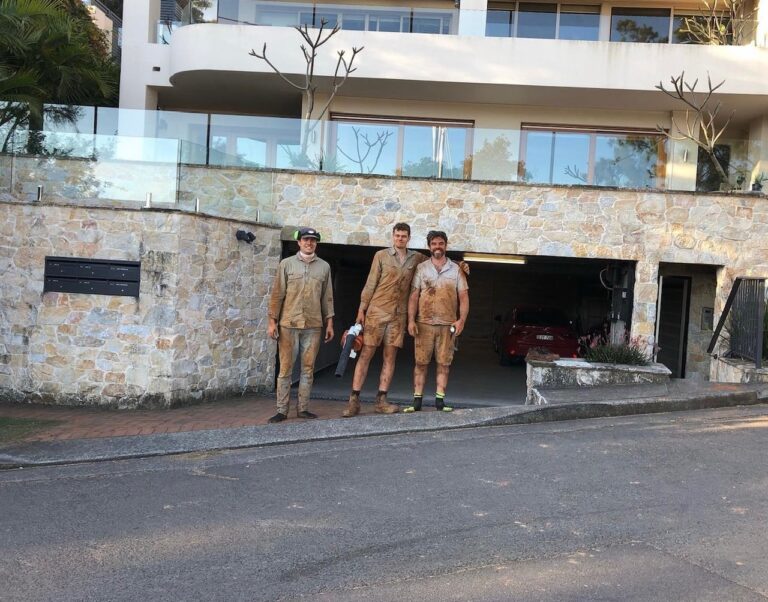
Sydney Gardeners is family operated and has been running for over twenty years, with eight-plus utes on the road and one training standard across all of them. The hardest conversation in planting is the one about spacing, because a correctly planted bed looks sparse on the day and full in three years, and the opposite is also true. We would rather have that conversation than come back in five years to take half of it out.
If our customers aren't happy, we aren't happy.
Lachlan Kavanagh
Operator of Sydney Gardeners
Same day quotes
Plant it once
Tell us the suburb, which way the bed faces and what you want it to do. We will come and look at the soil and the light, and you will get a planting plan with real species names and honest spacing on it.